
Understanding engagement score calculation

Engagement score is a key metric used to understand how satisfied and engaged employees feel across different aspects of the organization.
In Thrivesparrow, engagement scores can be calculated using:
- Favourability score
- Percentage score
- Absolute Score
These scores can also be measured at different levels depending on how results are analyzed.
Levels of measurement:
Engagement scores can be calculated at multiple levels within a survey:
- Question level – based on responses to an individual question
- Respondent level – based on responses across rating questions
- Reporting factor level – based on a specific reporting factor
- Organization level – overall engagement score
Favourability score calculation:
Favourability score measures the percentage of respondents who provided a positive response.
Favorable, neutral, and unfavorable responses:
Scale | Favorable | Neutral | Unfavorable |
5-point scale | 5, 4 | 3 | 2, 1 |
7-point scale | 7, 6 | 5, 4 | 3, 2, 1 |
10-point scale | 10, 9 | 8, 7 | 6 and below |
Formula:

Example:
Suppose 100 responses were collected on a 5-point scale, and 60 respondents selected either 4 or 5.
Calculation:
(60 ÷ 100) × 100 = 60%
Result:
60% is the favourability score.
Percentage score calculation:
Percentage score represents engagement by converting ratings into percentage values.
- If a single scale is used → average is converted to percentage
- If multiple scales are used → responses are normalized to a 100-point scale
For a 5-point scale
Actual Score | 0 | 1 | 2 | 3 | 4 | 5 |
Normalized score (%) | 0 | 20 | 40 | 60 | 80 | 100 |
7-point scale
Actual Score | 0 | 1 | 2 | 3 | 4 | 5 | 6 | 7 |
Normalised Score(%) | 0 | 14.28 | 28.57 | 42.85 | 57.14 | 71.42 | 85.71 | 100 |
For a 10-point scale
Actual score | 0 | 1 | 2 | 3 | 4 | 5 | 6 | 7 | 8 | 9 | 10 |
Normalized score (%) | 0 | 10 | 20 | 30 | 40 | 50 | 60 | 70 | 80 | 90 |
Calculating the average percentage score:
Once responses are converted into percentages:
- Add all converted scores
- Divide by total responses
Example 1:
Responses: 5, 4, 3, 4, 2
Step 1:
5 + 4 + 3 + 4 + 2 = 18
18 ÷ 5 = 3.6
Step 2:
3.6 ÷ 5 = 0.72
0.72 × 100 = 72%
Result:
Engagement score = 72%
Example 2:
Responses:
- 5-point → 4
- 7-point → 5, 6
Step 1: Convert
4 → 80%
5 → 71.42%
6 → 85.71%
Step 2: Add
80 + 71.42 + 85.71 = 237.13
Step 3: Average
237.13 ÷ 3 = 79.04%
Result:
Engagement score = 79.04%
Absolute score calculation:
In some cases, engagement scores are represented using the original rating scale instead of converting responses into percentages. This is known as the absolute score, where the average is calculated directly based on the selected rating scale.
Example:
In a 10-point scale, consider the following responses:
8, 7, 9, 6
Step 1: Add the scores
8 + 7 + 9 + 6 = 30
Step 2: Calculate the average
30 ÷ 4 = 7.5
Result:
The absolute engagement score is 7.5 / 10
Absolute scores use the original rating scale (such as 5-point, 7-point, or 10-point) without applying normalization or percentage conversion. While this makes them easy to interpret within the same scale, they may not be directly comparable across different rating scales.
How scores are used in reports:
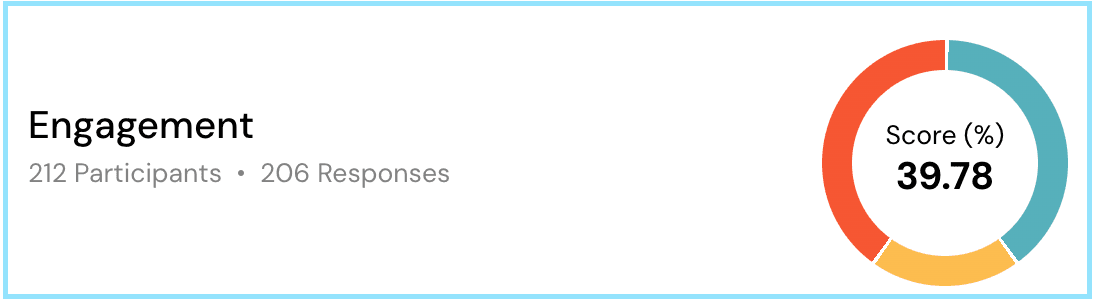
Engagement scores help you:
- Identify overall engagement trends
- Compare results across teams and time periods
- Understand areas that need improvement
A higher score indicates stronger engagement, while a lower score highlights potential concerns.
If you have any questions or need assistance understanding engagement scores, please feel free to reach out to our support team.